

Top 5 AI Real Estate Visualization Tools Compared
This article compares the best AI tools for property visualization and virtual home staging, showing how they affect real estate sales. It explains why staged listings attract more views, sell faster, and help buyers imagine a home more easily. The ranking evaluates each solution by render quality, pricing, turnaround time, and scalability. Tools covered include Globihome, Virtual Staging AI, REimagineHome, Nano Banana from Gemini, and Apply Design. The article also explains legal requirements for labeling visualized photos in the US and Europe, and gives practical advice on how many images should be staged in one listing for the best balance of realism and marketing impact.

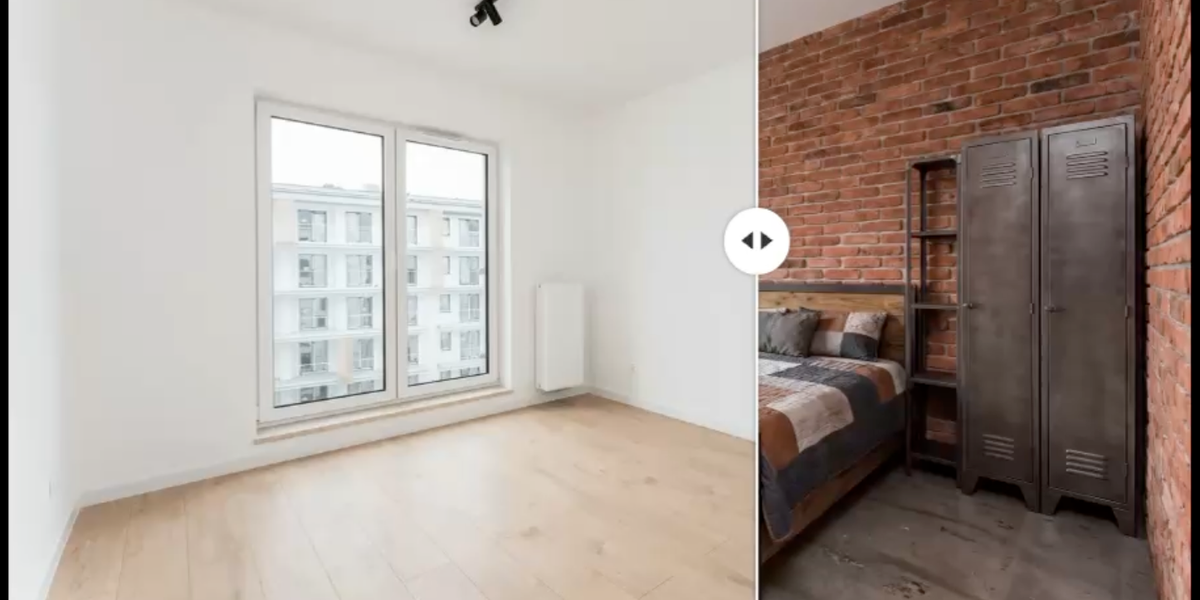
An empty apartment in a photo is a dead listing. Buyers scroll past it in three seconds because they cannot imagine what their future life would look like between bare walls. AI-powered virtual property visualization solves this problem in less than a minute and at a fraction of the cost of traditional home staging.
In this article, we look at the best AI tools for property visualization in 2026 – comparing prices, render quality, turnaround time, and which solutions actually speed up sales.
Why property visualization now has a real impact on sales
The market of virtual home staging is no longer a technological curiosity. According to the report 2025 Profile of Home Staging National Association of Realtors just 83% of agents representing buyers believe staging helps clients imagine a property as their future home.
Figures that may be important to you:
- 72% of agents in 2026 consider virtual staging an important element of effective listing sales.
- Listings with professional visualization generate even 40% more views than photos of empty interiors.
- Visualized properties sell on average 73% faster – in about 24 days instead of 90 days for listings without staging.
- 83% of buyer agents admit that staging helps clients imagine a property as their future home.
For property sellers, this means one thing: AI property visualization is no longer an add-on, but a standard, and its absence in a listing is starting to be noticeable in a negative way.
What is AI property visualization?
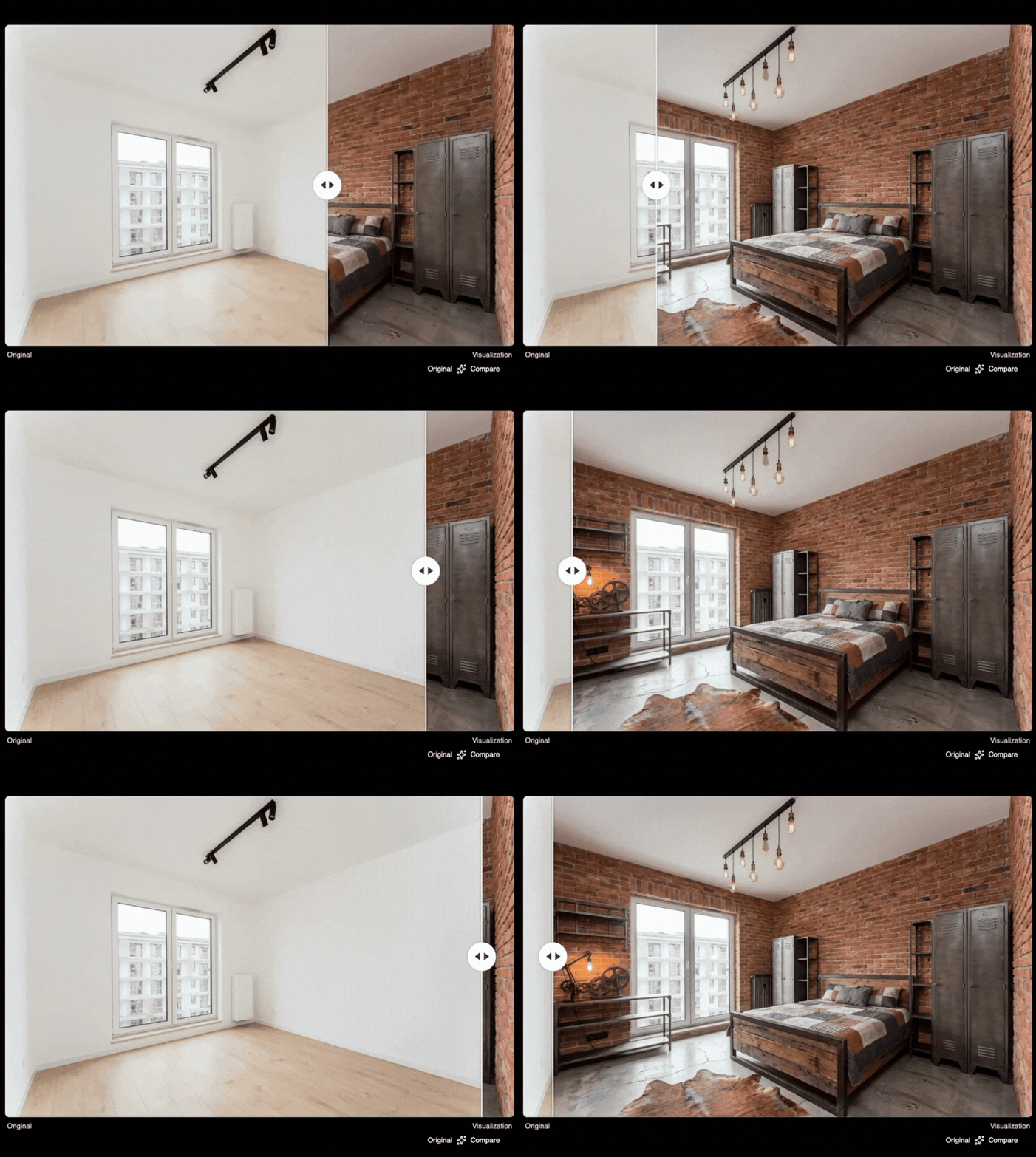
AI property visualization consists of digitally transforming a real photo of an apartment, house, office, or plot of land. The right tool can:
- furnish an empty living room or bedroom;
- remove old furniture and objects;
- change the interior style;
- show the potential result of a renovation;
- refresh floors, walls, or the kitchen;

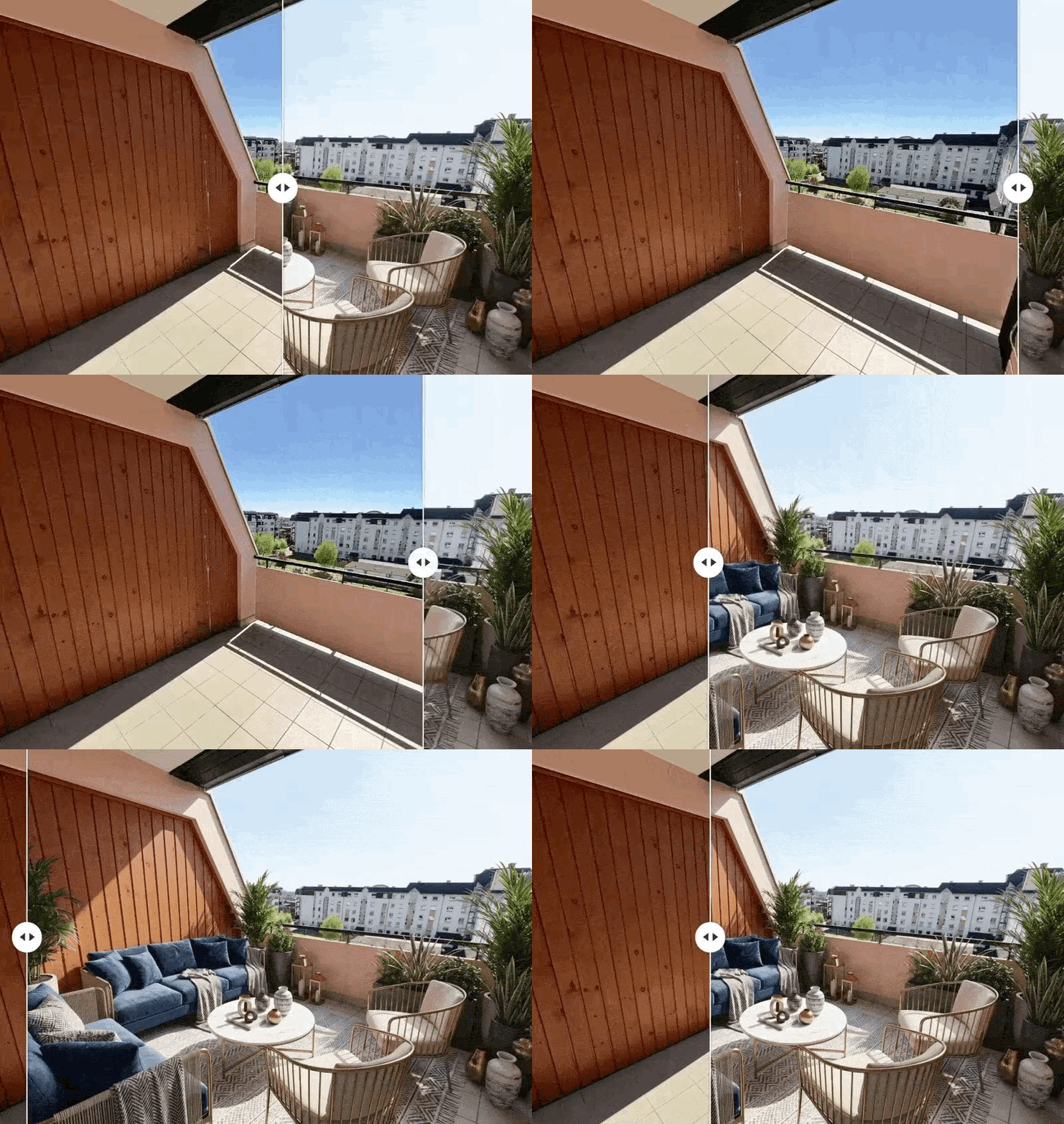
There are two main types of solutions on the market. The first includes specialized virtual home staging tools for real estate, such as Globihome, Virtual Staging AI, or Apply Design. The second consists of general-purpose models, primarily ChatGPT Images and Gemini Nano Banana, which allow photos to be edited using natural commands.
How we tested AI real estate visualization tools
When creating this ranking, we compared the tools against four criteria crucial for an agent's day-to-day work:
- Render quality and realism – do the shadows, furniture proportions, and perspective look believable?
- Price per photo – the actual cost at a volume of several dozen listings per month.
- Turnaround time – from a few seconds (pure AI) to 24–48 hours (services involving a designer).
- Scalability – whether the tool works well for one premium listing or for one hundred photos a month in a real estate office.
Top 5 Ranking of Real Estate Visualization Generators
Below you will find a comprehensive overview of the 5 best real estate visualization generation tools.
| Narzędzie | Typ | Cena za zdjęcie | Czas realizacji | Najlepsze dla |
| Globihome | AI-only, zintegrowana z platformą | wliczone w cenę subskrypcji | kilkanaście sekund | agenci, agencje i deweloperzy regularnie publikujący oferty |
| Virtual Staging AI | AI-only | od ok. 0,50 USD/zdjęcie | kilkanaście sekund | duży wolumen ofert, integracja z Zillow Showcase |
| REimagineHome | AI-only | ok. 19 USD/mies. za 30 zdjęć | poniżej 10 sekund | szybkie usuwanie mebli i błyskawiczny restyling |
| ApplyDesign | AI-only | od 25 USD/mies. za 20 zdjęć | do 1 minuty | powtarzalność i kontrola nad stylem |
#1. Globihome – the best tool for agents, agencies, and developers publishing listings
Globihome takes first place because it reduces the number of steps needed to prepare visualizations. The agent does not need to download photos from the listing, open an external platform, create a separate project, and upload the results again.
In Globihome, all you need to do is:
- Choose the photos intended for visualization;
- Select a style;
- Done;

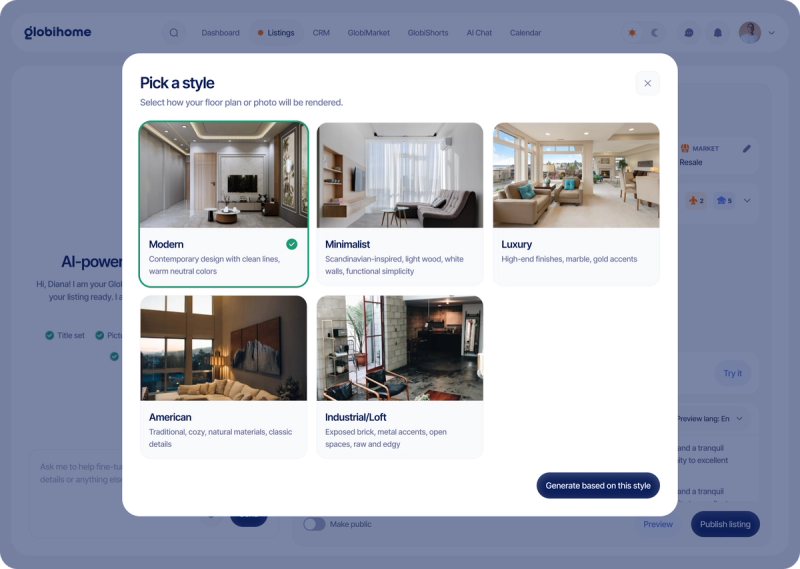
Available styles include:
- minimalist – suitable for new apartments and urban interiors;
- loft – for loft-style apartments, high ceilings, and open spaces;
- American – especially useful when presenting family homes;
- luxury – for penthouses, villas, and premium properties;
- modern – a versatile style for modern apartments and houses.

The huge advantage of Globihome is therefore not only image generation, but the combination of AI visualization with the process of preparing and publishing a real estate listing. Additionally, in Globihome everything is 100% transparent, so clients viewing listings can see which photo is a visualization and which is the original.
Biggest advantage: No additional tools or prompts. Everything is done in one window, and the Globihome AI perfectly understands the principles of room geometry and lighting, preserving 100% of the original wall layout.
#2. Virtual Staging AI – the best for quick home staging
Virtual Staging AI focuses on automatically furnishing empty and furnished rooms. The platform enables, among other things, removing furniture, regenerating layouts, enhancing photos, and preparing day-to-dusk variants. The manufacturer states that basic visualizations are delivered within a few dozen seconds.
Best for: agents who need to quickly prepare many standard visualizations of living rooms, bedrooms, and dining rooms.
Limitation: with more unusual architecture, the automatic result should be carefully checked for perspective, windows, doors, and furniture proportions.
#3. REimagineHome – best for extensive changes
REimagineHome combines AI virtual staging with conversational editing. The user can not only choose a style, but also describe further changes, work on reference photos, and develop an existing project without starting everything from scratch.
The tool supports interior design, facades, landscapes, and showcasing real products inside the interior.
Best for: premium agents, designers, and teams preparing several concepts for one property.
#4. Nano Banana from Gemini – best for multiple stylistic variants
Gemini z modelem Nano Banana stands out as a conversational photo editor. All you need to do is upload a photo and describe the change in simple language, e.g. ask to add a sofa, change the weather outside the window, or remove a scratch from the wall.
Its biggest advantage is the ability to improve the image step by step, in the form of a conversation. You can change the mood of the photo, perform virtual home staging, or remove individual imperfections without rebuilding the entire frame.

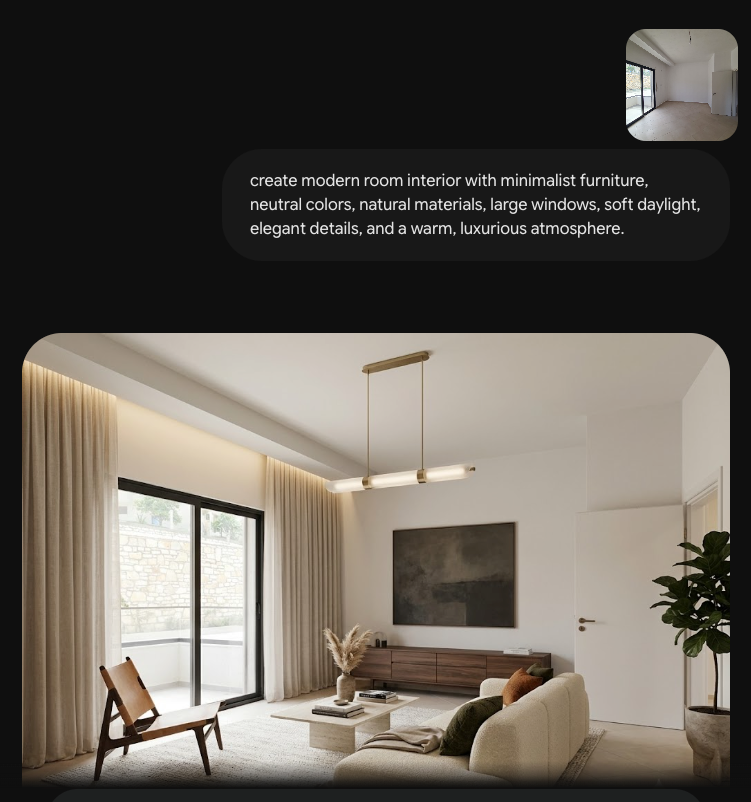
Gemini does not replace a professional graphic designer and still requires precise prompts. However, for fast, realistic property visualizations, it currently offers more predictable control over the edited photo than, for example, ChatGPT.
#5. Apply Design – best for controlling furniture placement
Apply Design offers both automatic staging and an editor that allows you to manually position furniture. Particularly useful is the ability to keep a similar arrangement across several photos of the same room.
The platform supports 2D and 360° photos, object removal, corrections, and working from multiple perspectives. The credit price starts at 7 USD when purchasing a larger package.
Best for: agents who want to control the placement of specific furniture instead of relying solely on automatic generation.
Property visualization in Globihome – without additional tools or subscriptions
Instead of juggling several platforms, logging separately into a staging generator, and manually exporting files to the CRM, in Globihome visualization is built directly into the listing-creation process. All you need to do as a seller is:
- Select the photos from your listing that you want to visualize.
- Choose the visualization style – you have five ready-made styles available: minimalist, loft, American, luxury, and modern.
- Done – the visualized photo goes directly to your listing gallery on the platform.

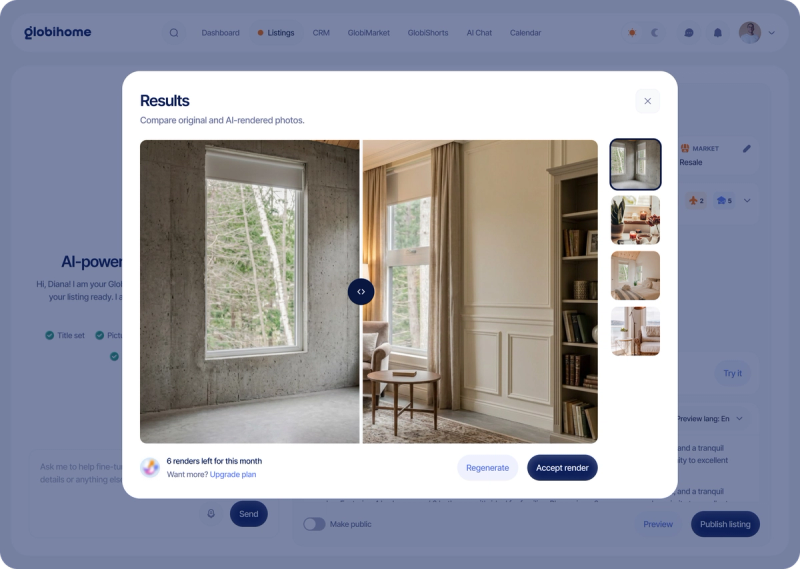
This solution is especially important for agents serving international clients – one listing in Globihome reaches buyers from different countries at the same time, so matching the visualization style (e.g. American for clients from the USA, minimalist for the Scandinavian market) can realistically increase the number of inquiries about a given property.
Legal requirements – labeling visualized photos in the USA and Europe
In the United States National Association of Realtors its Code of Ethics requires that photos subjected to virtual staging be clearly labeled as “virtually staged” in the description or photo caption. California went a step further – the law effective January 1, 2026, AB 723 requires not only labeling the photo, but also providing the buyer with a link or QR code to the original, unmodified image.
In Europe regulations vary by country, however good market practice – also used at Globihome – is always to clearly indicate that the presented photo is a visualization and not the actual furnishing state of the property. Transparency toward the buyer builds trust and protects the agent from accusations of misleading.
How many photos should be visualized in one listing? A practical rule
Experienced agents recommend visualizing 5–8 key photos per listing: living room, kitchen, primary bedroom, possibly the primary bathroom, and one exterior or facade shot. Visualizing every room, including hallways or the laundry room, reduces the listing’s credibility in the buyer’s eyes and gives the impression of “forced beautification”.
FAQ – most frequently asked questions about AI property visualization
Summary – which property visualization tool should you choose in 2026
- High listing volume, USA market – Virtual Staging AI thanks to integration with Zillow Showcase.
- Speed above all – REimagineHome, render under 10 seconds.
- Maximum flexibility and marketing materials “on the side” – Nano Banana, if you are already paying for those subscriptions for other tasks.
- Sales and management of international listings without additional tools – built-in visualization in Globihome, with different styles tailored to different buyer markets.
Regardless of the tool you choose, one thing remains unchanged: a visualized listing sells faster, generates more views, and creates the first impression that determines whether a showing gets scheduled. In the competitive 2026 real estate market, that is the difference between a listing that sits for months and one that disappears from the market in a few weeks.